
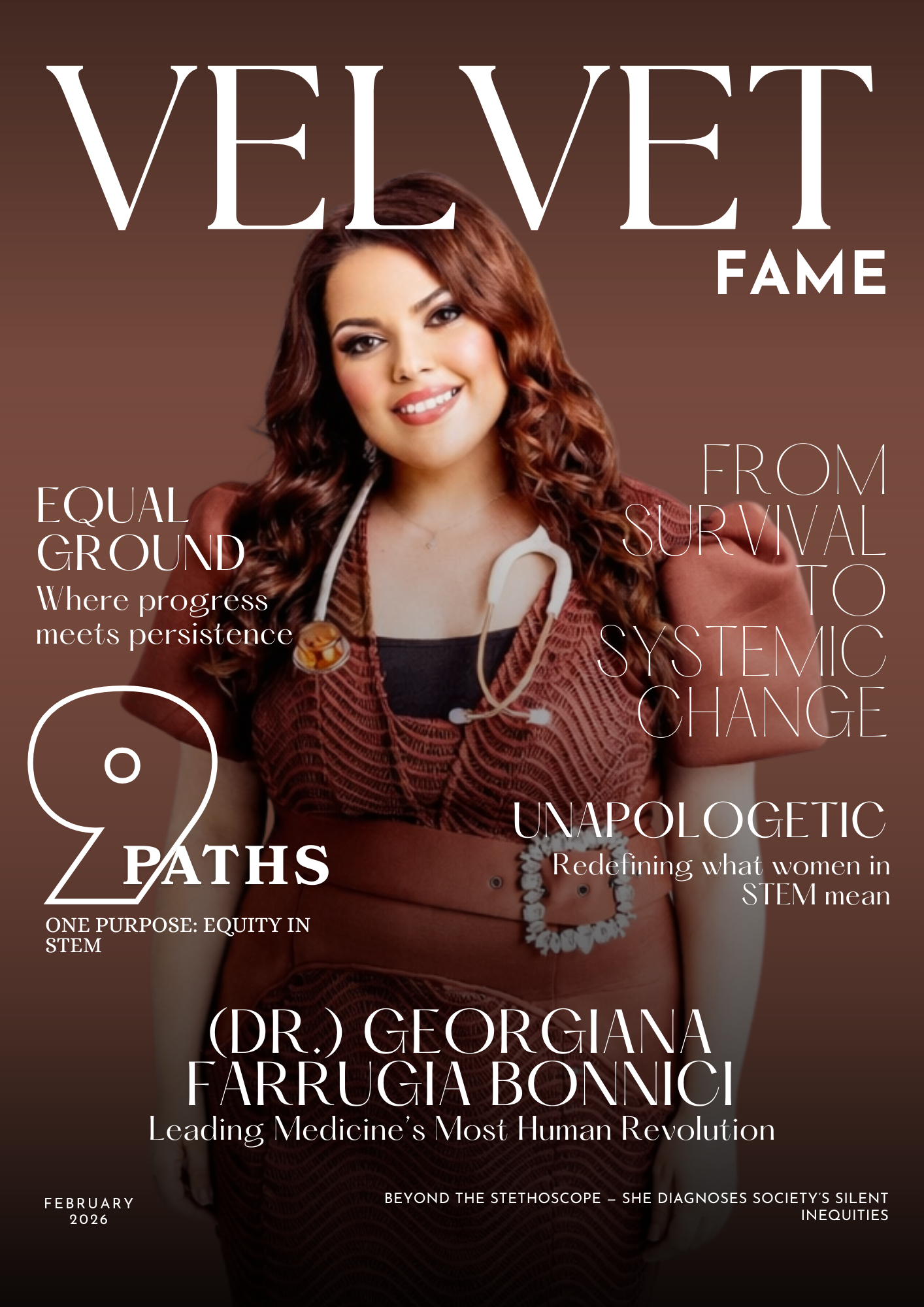
By DAME (DR.) GEORGIANA FARRUGIA BONNICI
As a female doctor working within STEM, I occupy a space shaped equally by science and by society’s expectations of women. Medicine is often perceived as one of the more welcoming STEM fields for women, particularly as medical schools across the world now graduate near-equal numbers of male and female doctors. On the surface, this appears to signal progress. Yet statistics alone do not tell the full story. Representation at entry level does not guarantee equality in leadership, influence, or long-term retention.
My journey through medicine has required resilience, persistence, and continual recalibration—qualities many women in STEM develop not by design, but by necessity.
The Illusion of Parity
In lecture halls and graduation ceremonies, parity seems visible. However, true equality is measured not only by who enters the field, but by who advances, who leads, and who shapes policy. Across STEM disciplines—including medicine—women remain underrepresented in senior consultant roles, academic chairs, research leadership, grant allocation panels, and institutional decision-making bodies.
The narrowing of representation along the career pipeline is not coincidental. It reflects cumulative structural and cultural barriers: implicit bias, unequal mentorship opportunities, inflexible systems that fail to accommodate caregiving responsibilities, and enduring assumptions that women must balance professional excellence with disproportionate emotional and domestic labour.
Progress at the entry level, while important, does not eliminate these systemic obstacles.
The Female Doctor’s Double Standard
From early training, female doctors often encounter subtle yet persistent double standards. Assertiveness may be interpreted as aggression. Firm boundaries may be labeled as “difficult.” Self-advocacy may be perceived as entitlement rather than professionalism.
In contrast, male colleagues are frequently presumed competent until proven otherwise. Women, conversely, are often required to demonstrate competence repeatedly before it is fully acknowledged—and even then, recognition may be attributed to diligence rather than intellect, teamwork rather than leadership.
In performance-driven STEM environments, these biases have tangible consequences. They influence promotion timelines, leadership invitations, speaking opportunities, and research collaborations. Over time, they also contribute to emotional fatigue—an invisible burden rarely reflected in institutional metrics.
Resilience Is Not Reform
Women in STEM are often praised for resilience. While resilience is admirable, it should not be mistaken for a systemic solution. Too often, the responsibility to adapt falls disproportionately on women: adapt your tone, adapt your schedule, adapt your ambition.
Medicine teaches that treating symptoms without addressing root causes leads to recurrence. Gender inequity is no different. Mentorship programmes, diversity panels, and inspirational campaigns are valuable—but insufficient without structural reform. True progress requires transparent promotion pathways, equitable access to research funding, accountable leadership, and policies that recognize caregiving as a shared societal responsibility rather than a personal limitation.
Institutional change must move beyond symbolic inclusion toward measurable equity.
Authority and Identity
For women who navigate additional layers of identity—cultural, racial, socioeconomic—the challenges are often amplified. Authority is not distributed equally; it is perceived through lenses shaped by longstanding norms.
As a female doctor, I have encountered situations where patients assumed a male colleague was “the doctor” while I was perceived as support staff. I have observed professional decisions questioned more rigorously when presented by women. These experiences are rarely dramatic enough to make headlines, yet frequent enough to shape confidence, perception, and professional trajectory.
STEM prides itself on objectivity. Yet human systems are inherently influenced by bias. Acknowledging this contradiction is not an attack on science—it is a commitment to improving it.
Why Women Strengthen STEM
The case for women in STEM is not rooted solely in fairness. It is rooted in excellence. Diverse teams consistently produce stronger research outcomes, more innovative solutions, and more comprehensive risk assessments. In medicine, diversity is directly linked to improved patient care and better health outcomes.
Gender-diverse teams ask different questions. They challenge assumptions that may otherwise go unexamined. They design systems that account for real populations rather than theoretical averages.
Women bring technical competence, clinical expertise, and analytical precision—alongside perspectives shaped by lived experience. These attributes are not peripheral to scientific progress; they are central to it.
Redefining Success
A transformative step for women in STEM is redefining success on our own terms. Success does not need to replicate traditionally male career trajectories to be legitimate. Leadership does not require the abandonment of empathy. Strength does not negate compassion.
For me, success has meant refusing to diminish myself in uncomfortable spaces, setting professional boundaries without apology, and contributing to systems—clinics, mentorship networks, collaborative teams—that reflect the values I believe medicine should embody.
It has also meant accepting that progress is rarely linear. Setbacks are not failures; they are data. In medicine, we reassess, recalibrate, and continue. The same principle applies to career development and systemic advocacy.
Responsibility to the Next Generation
Women established in STEM carry an important responsibility: visibility. Not perfection—visibility. Young women entering these fields do not need flawless role models; they need honest ones. They need to see that doubt and determination can coexist, that leadership can be cultivated, and that resilience does not require silence.
Each woman who persists in STEM expands the space for those who follow. Each voice that challenges inequity shifts the baseline of expectation. Change may be gradual, but it is cumulative.
Looking Ahead
The future of STEM depends on talent, innovation, and integrity. Marginalizing or underutilizing half the population compromises all three. Sustainable progress will not arise from passive optimism, but from evidence-based policy reform, institutional accountability, and leaders willing to interrogate entrenched norms.
From my position as a female doctor, I remain both critical and hopeful. Critical of systems that still demand disproportionate adaptation from women. Hopeful because change—though incremental—is measurable when driven by courage, collaboration, and data.
Women do not require permission to belong in STEM. We are already here—diagnosing, researching, engineering, innovating, and leading. The imperative now is not access, but equity: ensuring that women are heard, valued, and empowered to lead fully and unapologetically.
DAME (DR.) GEORGIANA FARRUGIA BONNICI
Specialist in Family Medicine
MRCGP (Int.), MSc Family Medicine, MD, BSc (Hons). Radiography
Diplomas in Cardiology, Gerontology & Geriatrics, Mindful Mental Health & Cognitive Behavioural Therapy, Nutrition & Dietetics, Homeopathy & Reflexology, Creative Writing & Interior Design













+ There are no comments
Add yours